 |
Why do we assess students'
learning?
This is not a simple question — there are many reasons why
we need to find out what students know and can do.
 The first place to
look for an answer may be in how we intend to use the information
obtained from assessments. For example, at the informal end of a
continuum of reasons for evaluation, we may listen in on pair work
to determine whether or not learners need more practice with today's
lesson. Observations may be noted on a checklist or stored in memory.
The results from this form of assessment are primarily intended
for use by the teacher in order to determine if progress is on track
and if more, or different, instruction is required. At the formal
end of the continuum, we might administer a statewide assessment
which students must pass in order to graduate. This type of assessment
may be mandated for the purpose of holding schools, teachers, and
students accountable for meeting high standards. Instruction, outcomes,
and assessment
The relationships
among purpose, information, interpretation, and decision making
are easy to imagine. Our reasons for evaluating students' learning
will determine the kind of information we seek, how we collect it,
how we interpret it, and how we use it. In this "Why assess?"
section, we focus on purpose. The remaining components are treated
in other sections.
In most classroom assessment, tests and other forms of evaluation
are linked to instruction. Instruction and assessment, if they are
to be well matched, should both be included in the planning process.

The needs
of learners are also important in planning for instruction and assessment.
Cohen
(1994) writes that language assessment promotes "meaningful
involvement of students with material that is central to the teaching
objectives of a given course. For this meaningful involvement to
take place, the goals of the assessment tasks need to reflect the
goals of the course, and these goals need to be made clear to the
students (p. 13)."
If all goes well,
instruction results in observable outcomes in learners, and assessment
provides the means to measure how well goals have been met. The results
of various forms of assessment usually comprise the bulk of what is reported
to students, parents, and administrators about student achievement.
| |
|
|
Some answers to our
question, "Why assess?"
To find out:
-
if instruction was effective,
-
if students need more instruction,
-
if students are ready for the next step,
-
If a different approach is required, and
-
how instruction can be improved the next
time this lesson is taught.
Teachers need to:
- provide diagnostic and formative feedback
to learners,
- gather information for reporting purposes (grades),
- identify the appropriate level for a new student (placement),
- determine whether or not a student meets
program requirements (certification), and
- motivate learners to study and make steady
progress.
Learners need to:
- know what is expected of them,
- know what they can do to improve their performance,
- understand what will comprise their course grade, and
- perceive evaluation as fair and meaningful.
Examples
|
|
| |
|
|
|
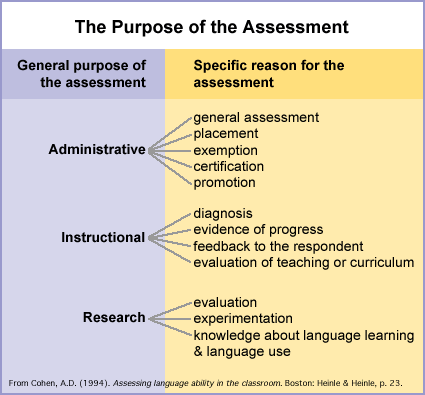
Cohen
(1994) identified a number of specific reasons for assessing
students' learning and organized them by administrative, instructional,
and research functions, as shown in the following chart.
To reflect the times we live in, we might add "accountability"
to the administrative functions of assessment — you may be
able to think of other reasons for assessment that are not covered
by these categories. For example, Shohamy
(2001) challenges us to identify some of the unspoken agendas
behind many of our stated reasons for testing.
Reflection
|
|
| |
|
|
|
- Imagine that your beginning level class is completing a unit
about pastimes: what you like/don’t like to do. Look at
the list of evaluations below and consider:
- What information will you gather from each item?
- Is this information useful?
- For what purpose(s)?
|
- Matching a list of pastimes to the appropriate pictures
of the activity.
- Labeling pictures of various activities (no list provided).
- Filling in the blank with the correct form of the
verb to say what various people like/don’t like
to do.
- Listening to someone name an activity and identifying
the picture of the activity that is named.
- Choosing the correct response from three or four choices
(multiple choice)
- Chapter test – written
- Rehearsed dialogue or skit
|
- If you limit your evaluations to the ones listed above, will
you know if your students can discuss with others and write about
their pastimes? What else would you have to do to make sure that
your students could successfully communicate with others about
their favorite/least favorite pastimes?
- Now think about the difference between recalling information
and applying information. If students can recall information (a
list of vocabulary words, the endings for regular verbs), it does
not mean that they can apply the information to communicate their
ideas and understand others’ ideas successfully. To gain
a complete picture of what students know and are able to do, how
must you design your assessments? How will this affect your instruction?
|
|
|
|
 به شما كاربر گرامي سلام عرض مي كنم . اميدوارم در اين وبلاگ دقايق خوبي را سپري كنيد.