A step-by-step approach to creating an assessment unit.
Creating an Assessment Unit |
| |||||||||||||||
Process |
||||||||||||||||
 |
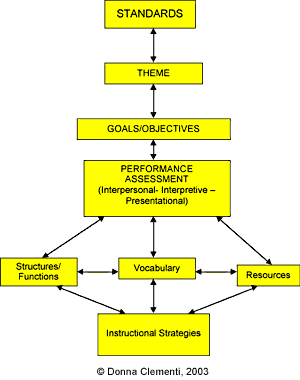
When creating an assessment unit, we are designing backwards.
StandardsLet’s begin at the top of the flow chart with the Standards. These are the National Standards for Foreign Language Learning, developed in 1999. States and school districts may have developed their own state and local standards. Generally, these documents reflect the overarching goals of the National Standards. The standards tell us in broad terms what should be taught in foreign language classrooms. A well-constructed performance assessment unit will incorporate all of the Five ‘C’s of the National Standards. The Standards are the foundation that influences all other decisions about planning a unit of instruction. They should be a constant point of reference as you plan our assessment unit. ThemeWith the Standards as a mindset, you can now select a theme. The theme has to reflect important learning—the theme has to be worth studying. It should address a “big idea” that has enduring value beyond the classroom (Wiggins & McTighe, 1998). For example, many foreign language students learn about clothing. Using “clothing” as the thematic center is not particularly intriguing: it is not a big idea. Think beyond a vocabulary theme to an important question: do you form opinions about people based on what they wear? Is what you wear a reflection of your personality? Do you stereotype people by their clothing styles? Would your characterizations of people based on what they wear be valid in another culture? A “big idea” might be responding to the question: “Does clothing tell a story?” You have now changed a vocabulary-based theme into an intriguing question to engage your students, a question that has value beyond the language classroom. Goals / ObjectivesAfter selecting the theme, you need to articulate why you are teaching this theme. What are your goals/objectives for this unit? You might think that the Standards are why you are teaching a particular theme. This is correct but remember that the Standards are broad statements. Goals/objectives are specific to the particular unit you are planning. What do you want the students to know and be able to do at the end of the unit? When determining goals/objectives, it is best to begin by brainstorming all the possible ideas related to the theme. Next organize the ideas into related categories. Finally, prioritize what is most important, what is most interesting, what helps respond to the theme. You should narrow your focus to three to five objectives/goals that are interrelated, that reflect increased communication, greater cultural insights, and an understanding of the theme. When you have your goals/objectives in place, you need to ask yourself: How will you know that the students have achieved the goals and objectives? This is your performance assessment, which is really at the heart of your unit. The performance assessment is the application of learning to a real-life situation. The performance assessment includes the three modes of Communication: interpersonal, interpretive, and presentational. Structures / Functions, Vocabulary, ResourcesThe next step in the flow chart is familiar ground. In order to successfully complete the performance assessment, what structures/functions and vocabulary are needed? And what resources are available to help teach the theme. Perhaps as you have thought about teaching a unit, you have started by saying “I need to teach past tense now” or “I need to teach clothing now”. By designing the assessment first, you can now purposefully select structures and vocabulary that will help the students reach the goals you have set for the unit.
| |||||||||||||||
 Instructional
Strategies
Instructional
Strategies|
Interpretive task: Read an article about someone who is currently famous in the target culture. Summarize the key facts about the person. Decide if the person will be remembered in history and give reasons for your response. Presentational task: Research a famous person from the target culture. Role-play the person and introduce yourself to the class, including why you are famous. Interpersonal task: In small groups, discuss what famous person you would like to meet and why. |
Write the rubrics for assessing each of the modes, or adapt a rubric you have used before that worked well. To see types of rubrics, see the Evaluation section.
Step 5: Identify structures and functions
In order to successfully complete the performance task, students will need to review adjective agreement and placement, and comparisons. They will also need to learn/review past tense.
Step 6: Identify vocabulary
Vocabulary for the theme “How long does fame last” may include physical and personality descriptors for people and professions.
Step 7: Choose instructional strategies
Focus on activities that will build a broad repertoire of descriptive words.
Reflection |
||||
|
| |||
 به شما كاربر گرامي سلام عرض مي كنم . اميدوارم در اين وبلاگ دقايق خوبي را سپري كنيد.